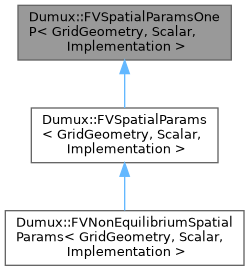
The base class for spatial parameters of one-phase problems using a fully implicit discretization method.
More...
template<class
GridGeometry, class Scalar, class Implementation>
class Dumux::FVSpatialParamsOneP< GridGeometry, Scalar, Implementation >
The base class for spatial parameters of one-phase problems using a fully implicit discretization method.
|
| | FVSpatialParamsOneP (std::shared_ptr< const GridGeometry > gridGeometry) |
| const GlobalPosition & | gravity (const GlobalPosition &pos) const |
| | Returns the acceleration due to gravity \(\mathrm{[m/s^2]}\).
|
| Scalar | harmonicMean (const Scalar T1, const Scalar T2, const GlobalPosition &normal) const |
| | Harmonic average of a discontinuous scalar field at discontinuity interface (for compatibility reasons with the function below).
|
| DimWorldMatrix | harmonicMean (const DimWorldMatrix &T1, const DimWorldMatrix &T2, const GlobalPosition &normal) const |
| | Harmonic average of a discontinuous tensorial field at discontinuity interface.
|
| template<class ElementSolution> |
| decltype(auto) | permeability (const Element &element, const SubControlVolume &scv, const ElementSolution &elemSol) const |
| | Function for defining the (intrinsic) permeability \([m^2]\).
|
| template<class ElementSolution> |
| Scalar | porosity (const Element &element, const SubControlVolume &scv, const ElementSolution &elemSol) const |
| | Function for defining the porosity. That is possibly solution dependent.
|
| template<class SolidSystem, class ElementSolution, typename std::enable_if_t< SolidSystem::isInert() &&SolidSystem::numInertComponents==1 &&!decltype(isValid(Detail::hasInertVolumeFractionAtPos< GlobalPosition, SolidSystem >())(std::declval< Implementation >()))::value, int > = 0> |
| Scalar | inertVolumeFraction (const Element &element, const SubControlVolume &scv, const ElementSolution &elemSol, int compIdx) const |
| | Function for defining the solid volume fraction. That is possibly solution dependent.
|
| template<class SolidSystem, class ElementSolution, typename std::enable_if_t< SolidSystem::numInertComponents==0, int > = 0> |
| Scalar | inertVolumeFraction (const Element &element, const SubControlVolume &scv, const ElementSolution &elemSol, int compIdx) const |
| template<class SolidSystem, class ElementSolution, typename std::enable_if_t<(SolidSystem::numInertComponents > 1)||((SolidSystem::numInertComponents > 0) &&(!SolidSystem::isInert()||decltype(isValid(Detail::hasInertVolumeFractionAtPos< GlobalPosition, SolidSystem >())(std::declval< Implementation >()))::value)), int > = 0> |
| Scalar | inertVolumeFraction (const Element &element, const SubControlVolume &scv, const ElementSolution &elemSol, int compIdx) const |
| Scalar | beaversJosephCoeffAtPos (const GlobalPosition &globalPos) const |
| | Function for defining the Beavers-Joseph coefficient for multidomain problems \(\mathrm{[-]}\).
|
| Scalar | forchCoeff (const SubControlVolumeFace &scvf) const |
| | Apply the Forchheimer coefficient for inertial forces calculation.
|
| const GridGeometry & | gridGeometry () const |
| | The finite volume grid geometry.
|
template<class
GridGeometry, class Scalar, class Implementation>
Returns the acceleration due to gravity \(\mathrm{[m/s^2]}\).
The default behaviour is a constant gravity vector; if the Problem.EnableGravity parameter is true, \(\boldsymbol{g} = ( 0,\dots,\ -9.81)^T \), else \(\boldsymbol{g} = ( 0,\dots, 0)^T \).
- Parameters
-
| pos | the spatial position at which to evaulate the gravity vector |

 1.16.1