 |
3.1-git
DUNE for Multi-{Phase, Component, Scale, Physics, ...} flow and transport in porous media
|
Loading...
Searching...
No Matches
| |
3.1-git
DUNE for Multi-{Phase, Component, Scale, Physics, ...} flow and transport in porous media
|
Test problem for the one-phase (Navier-) Stokes problem in a channel. More...
#include <test/freeflow/navierstokes/channel/2d/problem.hh>
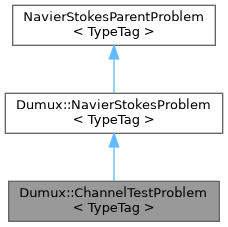
Test problem for the one-phase (Navier-) Stokes problem in a channel.
Flow from left to right in a two-dimensional channel is considered. At the inlet (left), fixed values for velocity are set, while at the outlet (right), a fixed pressure boundary condition is used. The channel is confined by solid walls at the top and bottom of the domain which corresponds to no-slip/no-flow conditions. For the non-isothermal test, water of increased temperature is injected at the inlet while the walls are fully isolating.
Public Member Functions | |
| ChannelTestProblem (std::shared_ptr< const GridGeometry > gridGeometry) | |
| Scalar | temperatureAtPos (const GlobalPosition &globalPos) const |
| Returns the temperature \(\mathrm{[K]}\) at a given global position. | |
| const GravityVector & | gravity () const |
| Returns the acceleration due to gravity. | |
| bool | enableInertiaTerms () const |
| Returns whether interia terms should be considered. | |
| template<class SolutionVector, class G = GridGeometry> | |
| std::enable_if< G::discMethod==DiscretizationMethod::staggered, void >::type | applyInitialFaceSolution (SolutionVector &sol, const SubControlVolumeFace &scvf, const PrimaryVariables &initSol) const |
| Applys the initial face solution (velocities on the faces). Specialization for staggered grid discretization. | |
| Scalar | pseudo3DWallFriction (const Scalar velocity, const Scalar viscosity, const Scalar height, const Scalar factor=8.0) const |
| An additional drag term can be included as source term for the momentum balance to mimic 3D flow behavior in 2D: | |
| template<class ElementVolumeVariables, class ElementFaceVariables, class G = GridGeometry> | |
| std::enable_if< G::discMethod==DiscretizationMethod::staggered, Scalar >::type | pseudo3DWallFriction (const SubControlVolumeFace &scvf, const ElementVolumeVariables &elemVolVars, const ElementFaceVariables &elemFaceVars, const Scalar height, const Scalar factor=8.0) const |
| Convenience function for staggered grid implementation. | |
| Scalar | permeability (const Element &element, const SubControlVolumeFace &scvf) const |
| Returns the intrinsic permeability of required as input parameter for the Beavers-Joseph-Saffman boundary condition. | |
| Scalar | alphaBJ (const SubControlVolumeFace &scvf) const |
| Returns the alpha value required as input parameter for the Beavers-Joseph-Saffman boundary condition. | |
| Scalar | betaBJ (const Element &element, const SubControlVolumeFace &scvf) const |
| Returns the alpha value required as input parameter for the Beavers-Joseph-Saffman boundary condition. | |
| Scalar | velocityPorousMedium (const Element &element, const SubControlVolumeFace &scvf) const |
| Returns the velocity in the porous medium (which is 0 by default according to Saffmann). | |
| const Scalar | bjsVelocity (const Element &element, const SubControlVolume &scv, const SubControlVolumeFace &faceOnPorousBoundary, const Scalar velocitySelf) const |
| helper function to evaluate the slip velocity on the boundary when the Beavers-Joseph-Saffman condition is used | |
| const Scalar | beaversJosephVelocity (const Element &element, const SubControlVolume &scv, const SubControlVolumeFace &faceOnPorousBoundary, const Scalar velocitySelf, const Scalar tangentialVelocityGradient) const |
| helper function to evaluate the slip velocity on the boundary when the Beavers-Joseph condition is used | |
Problem parameters | |
| Scalar | temperature () const |
| Returns the temperature within the domain in [K]. | |
| NumEqVector | sourceAtPos (const GlobalPosition &globalPos) const |
| Returns the sources within the domain. | |
Boundary conditions | |
| BoundaryTypes | boundaryTypesAtPos (const GlobalPosition &globalPos) const |
| Specifies which kind of boundary condition should be used for which equation on a given boundary control volume. | |
| PrimaryVariables | dirichletAtPos (const GlobalPosition &globalPos) const |
| Evaluates the boundary conditions for a Dirichlet control volume. | |
| template<class ElementVolumeVariables, class ElementFaceVariables> | |
| NumEqVector | neumann (const Element &element, const FVElementGeometry &fvGeometry, const ElementVolumeVariables &elemVolVars, const ElementFaceVariables &elemFaceVars, const SubControlVolumeFace &scvf) const |
| Evaluates the boundary conditions for a Neumann control volume. | |
| Scalar | parabolicProfile (const Scalar y, const Scalar vMax) const |
| A parabolic velocity profile. | |
| Scalar | dudy (const Scalar y, const Scalar vMax) const |
| The partial dervivative of the horizontal velocity (following a parabolic profile for Stokes flow) w.r.t. to the y-coordinate (du/dy). | |
Volume terms | |
| PrimaryVariables | initialAtPos (const GlobalPosition &globalPos) const |
| Evaluates the initial value for a control volume. | |
| void | setTimeLoop (TimeLoopPtr timeLoop) |
| Scalar | time () const |
|
inline |
|
inlineinherited |
Returns the alpha value required as input parameter for the Beavers-Joseph-Saffman boundary condition.
This member function must be overloaded in the problem implementation, if the BJS boundary condition is used.
|
inlineinherited |
Applys the initial face solution (velocities on the faces). Specialization for staggered grid discretization.
|
inlineinherited |
helper function to evaluate the slip velocity on the boundary when the Beavers-Joseph condition is used
|
inlineinherited |
Returns the alpha value required as input parameter for the Beavers-Joseph-Saffman boundary condition.
This member function must be overloaded in the problem implementation, if the BJS boundary condition is used.
|
inlineinherited |
helper function to evaluate the slip velocity on the boundary when the Beavers-Joseph-Saffman condition is used
|
inline |
Specifies which kind of boundary condition should be used for which equation on a given boundary control volume.
| globalPos | The position of the center of the finite volume |
|
inline |
Evaluates the boundary conditions for a Dirichlet control volume.
| globalPos | The center of the finite volume which ought to be set. |
|
inline |
The partial dervivative of the horizontal velocity (following a parabolic profile for Stokes flow) w.r.t. to the y-coordinate (du/dy).
| y | The position where the derivative is evaluated. |
| vMax | The profile's maxmium velocity. |
|
inlineinherited |
Returns whether interia terms should be considered.
|
inlineinherited |
Returns the acceleration due to gravity.
If the Problem.EnableGravity parameter is true, this means \(\boldsymbol{g} = ( 0,\dots,\ -9.81)^T \), else \(\boldsymbol{g} = ( 0,\dots, 0)^T \)
|
inline |
Evaluates the initial value for a control volume.
| globalPos | The global position |
|
inline |
Evaluates the boundary conditions for a Neumann control volume.
| element | The element for which the Neumann boundary condition is set |
| fvGeometry | The fvGeometry |
| elemVolVars | The element volume variables |
| elemFaceVars | The element face variables |
| scvf | The boundary sub control volume face |
|
inline |
A parabolic velocity profile.
| y | The position where the velocity is evaluated. |
| vMax | The profile's maxmium velocity. |
|
inlineinherited |
Returns the intrinsic permeability of required as input parameter for the Beavers-Joseph-Saffman boundary condition.
This member function must be overloaded in the problem implementation, if the BJS boundary condition is used.
|
inlineinherited |
An additional drag term can be included as source term for the momentum balance to mimic 3D flow behavior in 2D:
\[ f_{drag} = -(8 \mu / h^2)v \]
Here, \(h\) corresponds to the extruded height that is bounded by the imaginary walls. See Flekkoy et al. (1995) [25]
A value of 8.0 is used as a default factor, corresponding to the velocity profile at the center plane of the virtual height (maximum velocity). Setting this value to 12.0 corresponds to an depth-averaged velocity (Venturoli and Boek, 2006) [74].
|
inlineinherited |
Convenience function for staggered grid implementation.
|
inline |
|
inline |
Returns the sources within the domain.
| globalPos | The global position |
|
inline |
Returns the temperature within the domain in [K].
This problem assumes a temperature of 10 degrees Celsius.
|
inlineinherited |
Returns the temperature \(\mathrm{[K]}\) at a given global position.
This is not specific to the discretization. By default it just calls temperature().
| globalPos | The position in global coordinates where the temperature should be specified. |
|
inline |
|
inlineinherited |
Returns the velocity in the porous medium (which is 0 by default according to Saffmann).
 1.16.1