 |
version 3.11-dev
|
|
version 3.11-dev
|
Problem Description
Water at rest over a bed of variable elevation \(z(x, y)\) is a steady state of the shallow water equations: for a horizontal free surface \(h + z = H\) and zero velocity, the gradient of the hydrostatic pressure term \(\frac{1}{2} g h^2\) in the momentum flux is balanced by the bed slope source term \(-g h \nabla z\). Here \(h\) is the water depth, \(H\) the elevation of the free surface and \(g\) the gravitational acceleration. A scheme that preserves this state up to round-off satisfies the C-property [19] and is called well-balanced. A scheme that is not well-balanced generates velocities of the order of the bed variation.
The bed on the domain \([0, 2\,\mathrm{m}] \times [0, 1\,\mathrm{m}]\) consists of a smooth hump, the bed of the still water test of LeVeque [67], and a sill with discontinuous flanks,
\begin{align}z(x, y) = a \exp\left( -5\,\mathrm{m}^{-2} (x - 0.9\,\mathrm{m})^2 - 50\,\mathrm{m}^{-2} (y - 0.5\,\mathrm{m})^2 \right) + \begin{cases} b, & 1.4\,\mathrm{m} < x < 1.6\,\mathrm{m}, \\ 0, & \text{otherwise,} \end{cases} \end{align}
with the hump height \(a\) and the sill height \(b\). All boundaries are walls and there is no friction.
Exact Solution
The exact solution is the initial state, \(h = \max(H - z, 0)\) and \(u = v = 0\), where \(u\) and \(v\) are the velocity components in \(x\)- and \(y\)-direction. For \(H = 1\) m the bed is submerged everywhere. For \(H = 0.5\) m the top of the hump and the sill fall dry.
Parameters
| Parameter | Symbol | Value | Unit |
|---|---|---|---|
| Hump height | \(a\) | \(0.8\) | m |
| Sill height | \(b\) | \(0.6\) | m |
| Free surface elevation | \(H\) | \(1\) (submerged), \(0.5\) (emerged) | m |
| Water film on the dry bed | \(h_\mathrm{min}\) | \(0\) (submerged), \(10^{-5}\) (emerged) | m |
| Gravitational acceleration | \(g\) | \(9.81\) | m/s2 |
| Final time | \(t_\mathrm{end}\) | \(100\) | s |
| Time step size | \(\Delta t\) | \(10\) | s |
Setup
The shallow water model is discretized with cell-centered finite volumes (Two-point flux approximation (Tpfa)) on a grid of \(100 \times 50\) cells and the implicit Euler method. The bed elevation is constant in each cell and is evaluated at the cell center. The flux over a face is computed with the hydrostatic reconstruction of Audusse et al. [12]. The depths on both sides are reduced to the free surface above the higher of the two beds, \(h^* = \max(0, h + z - \max(z_\mathrm{in}, z_\mathrm{out}))\), the flux of the exact solution of the Riemann problem between the reconstructed states is evaluated, and the momentum flux is corrected by \(\frac{1}{2} g (h^{*2} - h^2)\). At rest, the reconstructed states on both sides of a face are equal, and the corrected momentum flux out of a cell is \(\frac{1}{2} g h^2\) of that cell on each of its faces, which sums to zero over the cell, also across the flanks of the sill.
A completely dry cell has no momentum storage, which makes the Jacobian of the momentum balance singular. Where the bed emerges, the depth is therefore set to a film of thickness \(h_\mathrm{min}\) (Problem.MinWaterDepth). The film on the sloping bed is not at rest itself, which limits the accuracy that can be reached on a partially dry bed.
The test test_shallowwater_lakeatrest (and _parallel on two processes) runs the submerged case and fails if the maximum deviation of the free surface elevation or of the specific discharge \(h \sqrt{u^2 + v^2}\) from the exact solution exceeds \(10^{-10}\) at \(t_\mathrm{end}\). The test test_shallowwater_lakeatrest_emerged runs the emerged case with the tolerance \(10^{-5}\).
Results
The figure and the table are produced by running
in the build directory test/freeflow/shallowwater/lakeatrest (requires NumPy and Matplotlib).
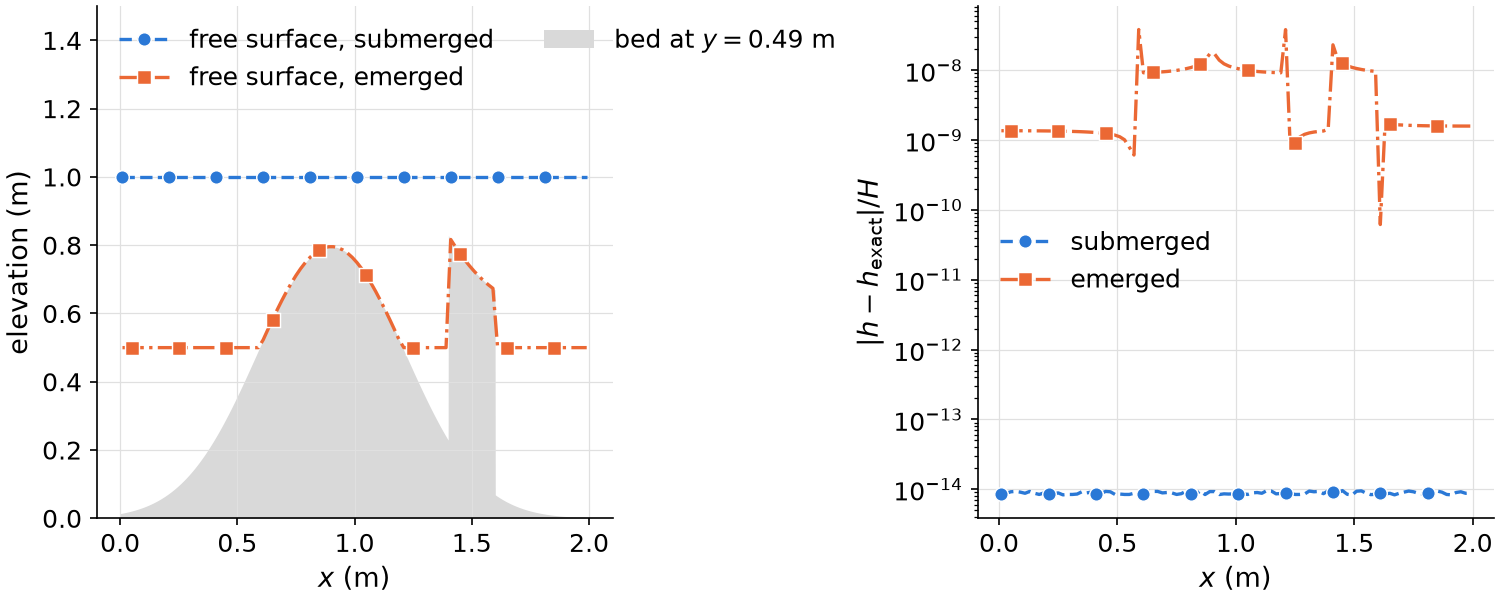
The table lists the maximum deviations at \(t_\mathrm{end}\) relative to the scales of the problem: the deviation of the free surface elevation relative to \(H\), and the deviation of the specific discharge relative to \(H \sqrt{g H}\), the discharge of water of depth \(H\) moving with the celerity \(\sqrt{g H}\).
| case | \(H\) (m) | \(h_\mathrm{min}\) (m) | max. deviation free surface / \(H\) | max. deviation specific discharge / \(H \sqrt{g H}\) |
|---|---|---|---|---|
| submerged | 1.0 | 0 | 9.4e-15 | 1.0e-14 |
| emerged | 0.5 | 1e-05 | 4.4e-07 | 3.9e-07 |
On the submerged bed the lake at rest is preserved to round-off. On the partially dry bed the deviation of the free surface is \(2.2 \cdot 10^{-7}\) m, 2.2 % of the film thickness.
3.11-dev
Generated by  1.16.1