 |
version 3.11-dev
|
|
version 3.11-dev
|
Problem description
A porous layer of height \(H\) between impermeable walls contains a fluid with solute mass fraction \(X = 1\) at the top and \(X = 0\) at the bottom. The density increases with \(X\), so the heavier fluid lies on top. The linear profile \(X = z/H\) at rest is a steady state. Above a critical Rayleigh number, perturbations of this state grow into convection cells [48] [57]. The benchmark compares the growth rate of a single convection cell with linear stability theory. It tests Darcy's law with the Boussinesq approximation, CVFEBoussinesqDarcysLaw.
With the Boussinesq approximation, the density varies only in the gravity term of Darcy's law,
\begin{align}\nabla \cdot \mathbf{v} = 0, \qquad \mathbf{v} = -\frac{K}{\mu} \left( \nabla p - (\varrho + \Delta\varrho X) \mathbf{g} \right), \qquad \phi \frac{\partial X}{\partial t} + \nabla \cdot \left( X \mathbf{v} - D_\mathrm{eff} \nabla X \right) = 0,\end{align}
where \(\mathbf{v}\) is the Darcy velocity, \(p\) the pressure, \(K\) the permeability, \(\mu\) the viscosity, \(\varrho\) the constant reference density of the fluid, \(\Delta\varrho\) the density increase at \(X = 1\), \(\mathbf{g}\) the gravitational acceleration with magnitude \(g\), \(\phi\) the porosity and \(D_\mathrm{eff} = \phi \tau D\) the effective diffusion coefficient with tortuosity \(\tau\) and molecular diffusion coefficient \(D\). The problem returns the density deviation \(\Delta\varrho X\) with buoyantDensity(volVars, phaseIdx); the fluid system returns the reference density \(\varrho\), which is also used in the storage and advection terms.
Linear stability theory
The only parameter of the problem is the Rayleigh number
\begin{align}Ra = \frac{K \Delta\varrho g H}{\mu D_\mathrm{eff}}.\end{align}
With lengths in units of \(H\) and time in units of \(\phi H^2 / D_\mathrm{eff}\), a perturbation \(X - z = A(t) \cos(k x) \sin(\pi z)\) of the linear profile with wavenumber \(k\) satisfies the linearized equations with \(A \propto e^{\sigma t}\) and the growth rate
\begin{align}\sigma = Ra \frac{k^2}{k^2 + \pi^2} - \left( k^2 + \pi^2 \right).\end{align}
Perturbations grow for \(Ra > (k^2 + \pi^2)^2 / k^2\). The smallest such Rayleigh number is \(Ra_c = 4 \pi^2\) at \(k = \pi\). The mode has no horizontal velocity at \(x = 0\) and \(x = \pi / k\), so a box of length \(L = \pi H / k\) with impermeable side walls contains exactly one convection cell.
Setup
The domain is the box \([0, L] \times [0, H]\) with \(L = H\), i.e. \(k = \pi\).
| Boundary | Flow | Transport |
|---|---|---|
| top, \(z = H\) | no flow | \(X = 1\) |
| bottom, \(z = 0\) | no flow, pressure fixed at \((0, 0)\) | \(X = 0\) |
| sides, \(x = 0\) and \(x = L\) | no flow | no flux |
The initial condition is \(X = z/H + A_0 \cos(\pi x / L) \sin(\pi z / H)\) with \(A_0 = 10^{-3}\) and the hydrostatic pressure of the linear profile.
| Parameter | Symbol | Value | Unit |
|---|---|---|---|
| Height, length | \(H\), \(L\) | 1, 1 | m |
| Reference density | \(\varrho\) | 1000 | kg/m³ |
| Density increase at \(X = 1\) | \(\Delta\varrho\) | 500 | kg/m³ |
| Viscosity | \(\mu\) | \(10^{-3}\) | Pa s |
| Molecular diffusion coefficient | \(D\) | \(10^{-9}\) | m²/s |
| Porosity | \(\phi\) | 0.4 | - |
| Tortuosity | \(\tau\) | 1 | - |
| Permeability | \(K\) | \(6.44 \times 10^{-15}\) | m² |
| Gravitational acceleration | \(g\) | 9.81 | m/s² |
The derived parameters are \(D_\mathrm{eff} = 4 \times 10^{-10}\) m²/s, the time unit \(\phi H^2 / D_\mathrm{eff} = 10^9\) s and \(Ra = 8 \pi^2 = 2 Ra_c\), for which \(\sigma = 2 \pi^2\). Since \(\sigma\) depends on the parameters only through \(Ra\), the density contrast \(\Delta\varrho / \varrho = 0.5\) does not change the growth rate of the Boussinesq model. It makes the result sensitive to the density in the storage and advection terms, which has to stay at the reference density \(\varrho\).
Discretization and measurement of the growth rate
The 1pnc with mass fractions is discretized with the box scheme (PQ1 CVFE (Box) scheme) on a structured grid. The total mass balance replaces the balance of the solvent, so that the boundaries with fixed mass fraction are impermeable. The constant-tortuosity model gives \(D_\mathrm{eff} = \phi \tau D\). Time integration uses the implicit Euler method with 20 steps of size \(\Delta t = 10^{-3}\) time units, Newton's method and a direct linear solver.
After each time step, the amplitude \(A_n\) is the projection of \(X - z/H\) onto the mode \(\cos(\pi x / L) \sin(\pi z / H)\), evaluated with the sub-control volumes as quadrature. An implicit Euler step multiplies a mode with growth rate \(\sigma_h\) by \(1 / (1 - \sigma_h \Delta t)\), so
\begin{align}\sigma_h = \frac{1 - A_{n-1} / A_n}{\Delta t}\end{align}
is the growth rate of the spatially discretized problem, without time discretization error. The error \(|\sigma_h - \sigma| / (k^2 + \pi^2)\) is measured at the last time step, relative to the diffusive decay rate \(k^2 + \pi^2\), which does not vanish at \(Ra = Ra_c\).
Results
The figures and the tables below are produced by running
in the build directory test/porousmediumflow/1pnc/1p2c/isothermal/hortonrogerslapwood. The images of this page are regenerated by passing doc/doxygen/images of the DuMux source directory as second argument. The script varies the Rayleigh number through the permeability.
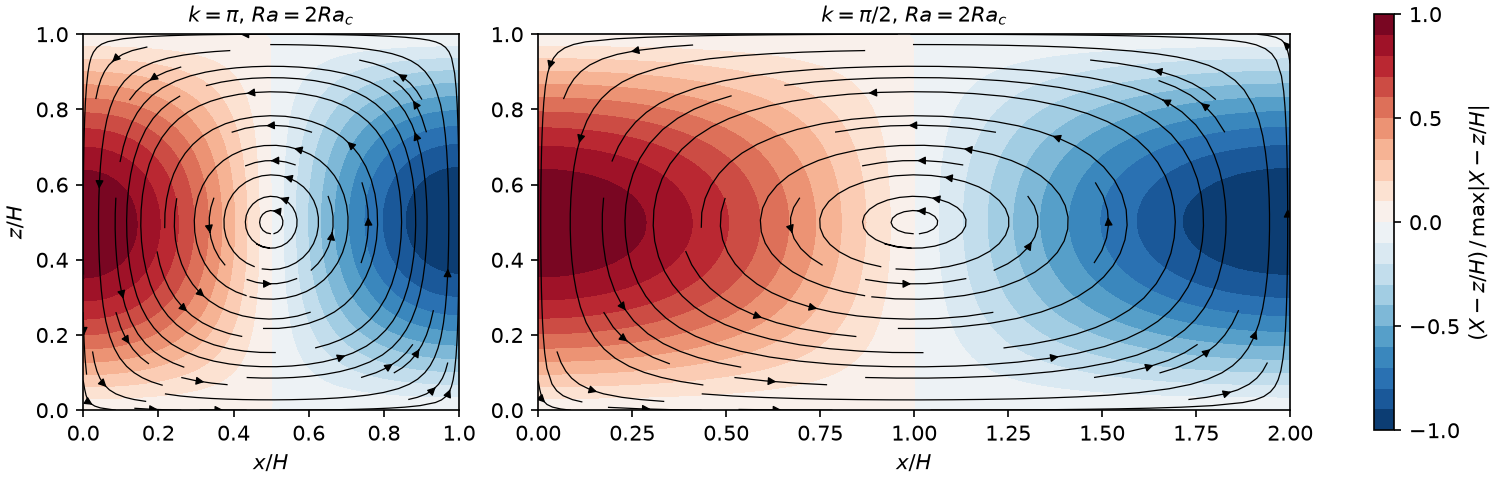
The figure above shows the perturbation \(X - z/H\) of the linear profile, normalized by its maximum, and streamlines of the Darcy velocity after 20 time steps at \(Ra = 2 Ra_c\), for \(k = \pi\) ( \(64 \times 64\) cells) and for \(k = \pi/2\) in the box \([0, 2H] \times [0, H]\) ( \(128 \times 64\) cells). Fluid with excess solute (red) is denser and sinks, depleted fluid (blue) rises. The box of length \(2H\) contains a single elongated cell: the initial condition contains only the mode with \(k = \pi/2\), and the mode with \(k = \pi\), which forms two cells and grows faster at this Rayleigh number ( \(\sigma = 2\pi^2\) against \(\sigma = 3.45\)), stays at round-off level (relative amplitude \(6 \times 10^{-13}\) after 20 time steps). The normalized perturbation differs from the mode shape \(\cos(k x) \sin(\pi z / H)\) by at most \(1.1 \times 10^{-2}\) for \(k = \pi\) and \(4.8 \times 10^{-3}\) for \(k = \pi/2\). For \(k = \pi\), the difference is \(2.1 \times 10^{-2}\), \(1.1 \times 10^{-2}\) and \(5.9 \times 10^{-3}\) on \(32 \times 32\), \(64 \times 64\) and \(128 \times 128\) cells, and \(2.0 \times 10^{-2}\), \(1.0 \times 10^{-2}\) and \(5.0 \times 10^{-3}\) with the smaller initial amplitude \(A_0 = 10^{-4}\), so it is a discretization error. It comes from the upwind weighting of the advective flux: with central weighting (Flux.UpwindWeight = 0.5), the difference for \(k = \pi/2\) drops from \(4.8 \times 10^{-3}\) to \(3.4 \times 10^{-4}\), while the growth rate changes from 3.4451 to 3.4463 (exact 3.4544).
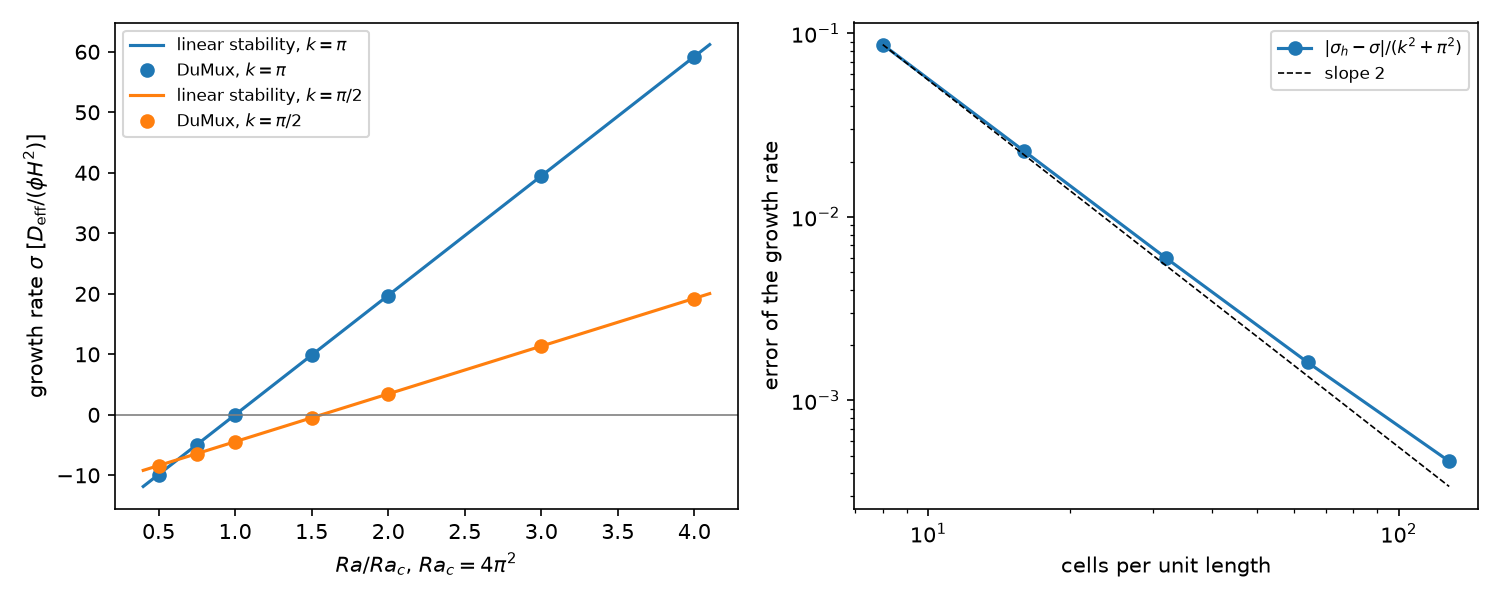
For \(Ra = 8 \pi^2\) and \(k = \pi\), the growth rate converges with second order under grid refinement:
| Grid | \(\sigma_h\) | error | rate |
|---|---|---|---|
| \(8 \times 8\) | 18.02445 | \(8.69 \times 10^{-2}\) | - |
| \(16 \times 16\) | 19.28944 | \(2.28 \times 10^{-2}\) | 1.93 |
| \(32 \times 32\) | 19.62142 | \(5.97 \times 10^{-3}\) | 1.93 |
| \(64 \times 64\) | 19.70738 | \(1.61 \times 10^{-3}\) | 1.89 |
| \(128 \times 128\) | 19.73002 | \(4.66 \times 10^{-4}\) | 1.79 |
The exact growth rate is \(\sigma = 2 \pi^2 = 19.73921\). For \(0.5 \leq Ra / Ra_c \leq 4\) on \(64 \times 64\) cells, the error is between \(2.0 \times 10^{-5}\) and \(4.7 \times 10^{-3}\). In the box \([0, 2H] \times [0, H]\) with \(128 \times 64\) cells, the mode with \(k = \pi/2\) grows for \(Ra / Ra_c > 1.5625\), and the error is between \(4.2 \times 10^{-5}\) and \(1.9 \times 10^{-3}\). Without perturbation ( \(A_0 = 0\)), the maximum deviation from the linear profile after 20 time steps is \(2.2 \times 10^{-16}\): the discrete solution at rest is a steady state.
The test test_1p2c_hortonrogerslapwood_box runs the setup above on \(32 \times 32\) cells and fails if the error exceeds \(10^{-2}\). The test test_1p2c_hortonrogerslapwood_decay_box uses \(Ra = 2 \pi^2\), for which the perturbation decays with \(\sigma = -\pi^2\); its error is \(1.3 \times 10^{-4}\).
3.11-dev
Generated by  1.16.1