 |
version 3.11-dev
|
|
version 3.11-dev
|
Problem Description
A horizontal channel without friction, of length \(L\) and width \(W\), is divided by a gate at \(x = x_0\). At \(t = 0\) the water is at rest, with the depth \(h_L\) upstream and \(h_R < h_L\) downstream of the gate, and the gate is removed at once. All boundaries are walls.
The water depth \(h\) and the depth-averaged velocity \(u\) along the channel satisfy the one-dimensional shallow water equations
\begin{align}\frac{\partial h}{\partial t} + \frac{\partial (h u)}{\partial x} = 0, \qquad \frac{\partial (h u)}{\partial t} + \frac{\partial}{\partial x} \left( h u^2 + \frac{1}{2} g h^2 \right) = 0, \end{align}
where \(g\) is the gravitational acceleration. The flow does not vary across the channel and the velocity component \(v\) across the channel vanishes.
Exact Solution
Until the waves reach the end walls, the solution is the self-similar solution of the Riemann problem with the states \((h_L, 0)\) and \((h_R, 0)\) given by Stoker [107] (see also the compilation of shallow water solutions SWASHES [35]). A rarefaction wave travels upstream and a bore downstream. Between them, the depth \(h_m\) and the velocity \(u_m\) are constant. With the celerities \(c_L = \sqrt{g h_L}\) and \(c_m = \sqrt{g h_m}\), the depth \(h_m\) is the root of
\begin{align}2 \left( c_L - c_m \right) = \left( h_m - h_R \right) \sqrt{\frac{g}{2} \frac{h_m + h_R}{h_m h_R}}, \end{align}
where the left side is the velocity behind the rarefaction wave and the right side the velocity behind the bore. Then \(u_m = 2 (c_L - c_m)\) and the bore moves with the speed \(s = h_m u_m / (h_m - h_R)\). With \(\xi = (x - x_0)/t\), the solution is
\begin{align}(h, u) = \begin{cases} (h_L, 0), & \xi \leq -c_L, \\ \left( (2 c_L - \xi)^2 / (9 g), \; 2 (c_L + \xi) / 3 \right), & -c_L < \xi \leq u_m - c_m, \\ (h_m, u_m), & u_m - c_m < \xi \leq s, \\ (h_R, 0), & \xi > s. \end{cases} \end{align}
For the parameters below, \(h_m = 2.2070\) m, \(u_m = 3.2223\) m/s and \(s = 5.8921\) m/s. At the final time \(t_\mathrm{end}\), the head of the rarefaction wave is at \(x = 3.74\) m and the bore at \(x = 15.89\) m.
Parameters
| Parameter | Symbol | Value | Unit |
|---|---|---|---|
| Channel length | \(L\) | \(20\) | m |
| Channel width | \(W\) | \(5\) | m |
| Gate position | \(x_0\) | \(10\) | m |
| Initial depth upstream | \(h_L\) | \(4\) | m |
| Initial depth downstream | \(h_R\) | \(1\) | m |
| Gravitational acceleration | \(g\) | \(9.81\) | m/s2 |
| Final time | \(t_\mathrm{end}\) | \(1\) | s |
Setup
The shallow water model is discretized with cell-centered finite volumes (Two-point flux approximation (Tpfa)) and the implicit Euler method. The flux over a face is the flux of the exact solution of the Riemann problem between the states of the two adjacent cells. At the walls, the outside state is the inside state with the normal velocity reversed. The scheme is first order in space and time. The test computes the exact solution with the same Riemann solver and writes it to the output (exactWaterDepth, exactVelocityX).
The grid of params.input has 100 cells along and 25 cells across the channel, and the time step size is \(\Delta t = 0.005\) s. The test test_shallowwater_dambreak_sequential (and _parallel on two processes) compares the solution at \(t_\mathrm{end}\) with a reference solution. For the grid study, the channel is resolved with \(N\) cells along and one cell across the channel, and the time step size is \(\Delta t = 0.5\,\mathrm{s}/N\), such that the Courant number \(c_L \Delta t / \Delta x = 0.16\), with the cell size \(\Delta x = L/N\), is the same on all grids.
Results
The figure and the tables are produced by running
in the build directory test/freeflow/shallowwater/dambreak (requires NumPy, SciPy and Matplotlib). The script computes the exact solution independently of DuMux. It agrees with the exact solution written by the test to within \(10^{-13}\) m. For comparison, the script also solves the dam break with a textbook first-order Godunov scheme, the exact Riemann solver with the explicit Euler method, on the same grids and with the same time step sizes.
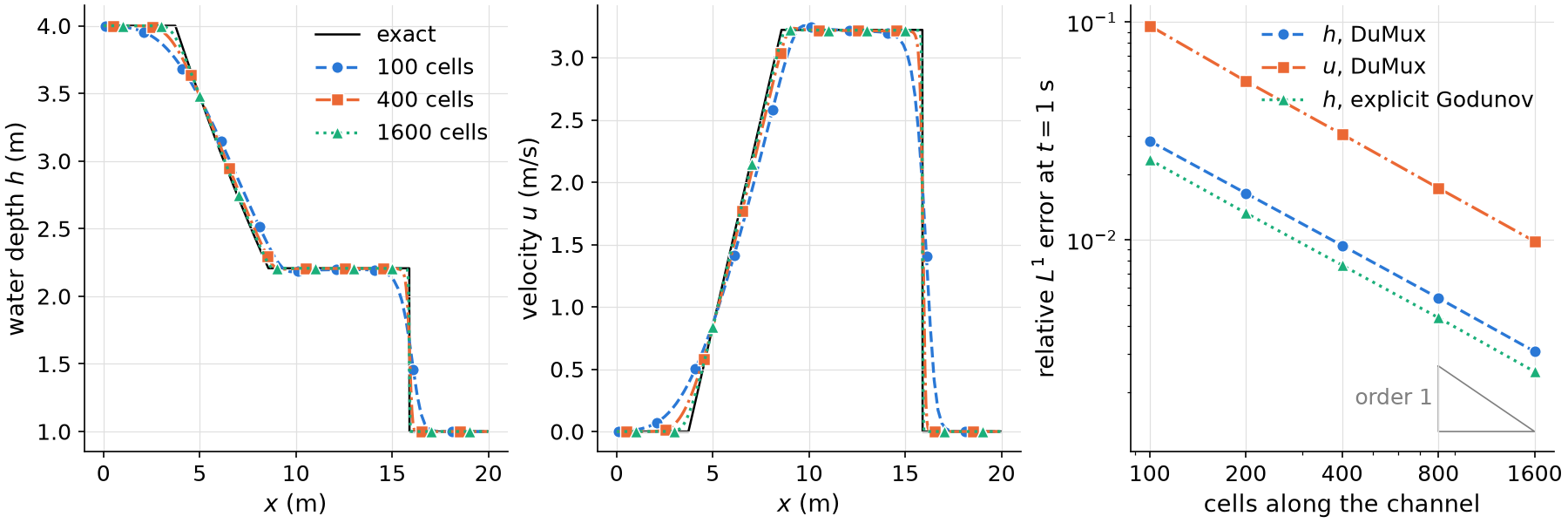
The table lists the relative discrete \(L^1\) errors at \(t_\mathrm{end}\), \(\| e \|_1 / \| h \|_1\) for the depth and \(\| e \|_1 / \| u \|_1\) for the velocity, with \(\| e \|_1 = \sum_i |V_i| \, |e_i|\), where \(e_i\) is the difference to the exact solution at the center of the cell \(V_i\) with area \(|V_i|\), and the norms of the exact solution evaluated in the same way. The \(L^1\) norm is used because the solution is discontinuous at the bore: there, the error is of the order of the jump over a width proportional to \(\Delta x\), which gives \(L^1\) errors proportional to \(\Delta x\) but \(L^2\) errors proportional to \(\Delta x^{1/2}\).
| \(N\) | \(\Delta t\) (s) | rel. \(L^1\) error \(h\) | rate | rel. \(L^1\) error \(u\) | rate | rel. \(L^1\) error \(h\), explicit Godunov | rate |
|---|---|---|---|---|---|---|---|
| 100 | 5.000e-03 | 2.841e-02 | - | 9.613e-02 | - | 2.330e-02 | - |
| 200 | 2.500e-03 | 1.633e-02 | 0.80 | 5.346e-02 | 0.85 | 1.325e-02 | 0.81 |
| 400 | 1.250e-03 | 9.405e-03 | 0.80 | 3.047e-02 | 0.81 | 7.631e-03 | 0.80 |
| 800 | 6.250e-04 | 5.392e-03 | 0.80 | 1.727e-02 | 0.82 | 4.381e-03 | 0.80 |
| 1600 | 3.125e-04 | 3.063e-03 | 0.82 | 9.826e-03 | 0.81 | 2.475e-03 | 0.82 |
Both errors converge with approximately first order. The explicit Godunov scheme converges with the same rates, and its errors are smaller by a factor of 1.22 to 1.24. The rates are therefore a property of first-order schemes for this solution and not of the implicit time discretization. The script splits the relative \(L^1\) error of the depth into the contributions of the cells within 1 m of each wave. Near the bore, the contribution converges with approximately first order, from \(9.93 \times 10^{-3}\) on 100 cells to \(6.45 \times 10^{-4}\) on 1600 cells. Near the head of the rarefaction wave, where the exact depth has a kink, it converges more slowly, from \(6.04 \times 10^{-3}\) to \(1.08 \times 10^{-3}\), and makes up 35 % of the error on 1600 cells.
The test test_shallowwater_dambreak_convergence runs the grids with 100, 200 and 400 cells and checks that the mean convergence rates of the relative \(L^1\) errors of depth and velocity are at least 0.7.
3.11-dev
Generated by  1.16.1