 |
version 3.11-dev
|
|
version 3.11-dev
|
A fluid-saturated porous sphere is loaded on its drained surface. The pore pressure at the centre first rises above the load and then decays (Mandel–Cryer effect). Cryer [33] solved the problem in linear poroelasticity. The benchmark solves it with linear poroelasticity (Solid mechanics with fluid pressure coupled to 1p, test/poromechanics/poroelastic/cryer) and with the large-deformation poroelastic model (Large-deformation poroelasticity, test/poromechanics/poroelastic_large_deformations/cryer). With a small load, both are compared with Cryer's solution. With larger loads, the large-deformation model shows the effect of finite deformation and of a permeability that depends on the deformation.
The sphere has the radius \(R_0 = 1\) m; one octant is modelled.
In linear poroelasticity, the total stress is \(\boldsymbol{\sigma} = \lambda \operatorname{tr}(\boldsymbol{\varepsilon}) \mathbf{I} + 2G \boldsymbol{\varepsilon} - \alpha_B p_f \mathbf{I}\) with \(\lambda = K - \tfrac{2}{3} G\), and the porosity \(\phi = \phi_0 + \alpha_B \nabla \cdot \mathbf{u} + S_p p_f\) gives the storage \(\alpha_B \partial_t \nabla \cdot \mathbf{u} + S_p \partial_t p_f\).
In the large-deformation model, the skeleton is a Neo-Hookean material with volumetric–isochoric split, isochoric stress \(\mathbf{P}_\text{iso} = G J^{-2/3}(\mathbf{F} - \tfrac{1}{3}\operatorname{tr}(\mathbf{C})\, \mathbf{F}^{-\top})\) and solid pressure \(p_s = \frac{K}{2}(J - J^{-1})\). The model adds \((p_s - \alpha_B p_f) J \mathbf{F}^{-\top}\) to the stress and has the storage \(\alpha_B \partial_t J + S_p \partial_t p_f\); see Large-deformation poroelasticity for the equations. For small deformations, both models have the same linearization.
| Parameter | Symbol | Value |
|---|---|---|
| shear modulus | \(G\) | 1.5 MPa |
| drained bulk modulus | \(K\) | 1.0 MPa |
| Poisson's ratio of the linearized skeleton | \(\nu\) | 0 |
| Biot coefficient | \(\alpha_B\) | 1 |
| storage coefficient | \(S_p\) | 0 |
| initial porosity | \(\phi_0\) | 0.5 |
| initial permeability | \(\kappa_0\) | \(10^{-12}\) m² |
| fluid viscosity | \(\mu_f\) | \(10^{-3}\) Pa s |
| surface load | \(p_0\) | 100 Pa, 0.25 MPa or 0.5 MPa ( \(p_0/K = 10^{-4}\), 0.25, 0.5) |
The permeability of the large-deformation model is either constant, \(\kappa = \kappa_0\), or follows the Kozeny–Carman law \(\kappa(J) = \frac{d_p^2}{180} \frac{\phi^3}{(1 - \phi)^2}\) with the porosity \(\phi(J) = 1 - (1 - \phi_0)/J\) and the particle diameter \(d_p\) chosen such that \(\kappa(1) = \kappa_0\) (SpatialParams.PermeabilityModel). In linear poroelasticity, the permeability is constant, and \(p_f/p_0\) does not depend on the load.
In linear poroelasticity, the pore pressure is
\begin{align}\frac{p(r,t)}{p_0} = 2mB \sum_{i=1}^{\infty} \frac{\sin z_i - z_i \operatorname{sinc}(z_i r/R_0)}{m z_i \cos z_i + (2m-1)\sin z_i} \exp\left(-\frac{z_i^2 c_v t}{\beta R_0^2}\right), \qquad \operatorname{sinc}(x) = \frac{\sin x}{x},\end{align}
where the \(z_i\) are the positive roots of \((1 - m z^2)\sin z - z\cos z = 0\) and
\begin{align}m = \frac{K + \tfrac{4}{3}G}{4G}\left(1 + \frac{K S_p}{\alpha_B^2}\right), \qquad c_v = \frac{\kappa}{\mu_f}\left(K + \tfrac{4}{3}G\right), \qquad \beta = \alpha_B^2 + \left(K + \tfrac{4}{3}G\right) S_p, \qquad B = \frac{\alpha_B}{\alpha_B^2 + K S_p}.\end{align}
\(B\) is Skempton's coefficient, the uniform pore pressure \(B p_0\) right after loading. With the parameters above, \(m = 0.5\), \(c_v = 3 \times 10^{-3}\) m²/s, \(\beta = 1\), \(B = 1\), and the centre pressure has its maximum 1.575 \(p_0\) at \(t c_v/R_0^2 = 0.0625\). test/poromechanics/cryer_analytical.hh implements the series.
Linear poroelasticity: the pressure is cell-centred with the multi-point flux approximation (Multi-point flux approximation (Mpfa)), since the two-point flux approximation is not consistent on the tetrahedral mesh; the displacement is linear with the box scheme (PQ1 CVFE (Box) scheme). The two subdomains are coupled with PoroMechanicsCouplingManager (Multidomain framework). Permeability and fluid density do not depend on the deformation, so the coupling manager of the test restricts the dependence of the flow residual on the displacement to the vertices of the element (test/poromechanics/poroelastic/cryer/couplingmanager.hh). The centre pressure is the value of the cell at the centre, compared with Cryer's solution at the centre of that cell.
Large deformation: the displacement is quadratic with the hybrid control-volume / finite-element scheme (PQ2 CVFE scheme), solid and fluid pressure are linear with the box scheme (PQ1 CVFE (Box) scheme), coupled as three subdomains (Multidomain framework).
The tests use the mesh test/poromechanics/sphere_eighth_coarse.msh (223 vertices, 670 tetrahedra). The benchmark runs use the mesh sphere_eighth.msh that gmsh generates from test/poromechanics/sphere_eighth.geo with the maximum element size 0.095 m; with gmsh 4.13.1 it has 862 vertices and 3297 tetrahedra. Time integration uses the multi-stage time stepper with the third-order diagonally implicit Runge–Kutta method DIRK3 (TimeLoop.Scheme, implicit Euler is also available). The time step starts at 1 s and grows by the factor 1.3 per step up to 20 s, which reaches \(R_0^2/c_v = 333.33\) s in 25 steps.
Centre pressure \(p/p_0\) and volume ratio \(J\) at the centre, mesh sphere_eighth.msh (gmsh 4.13.1), DIRK3, 25 steps:
| model | permeability | \(p_0/K\) | maximum of \(p/p_0\) (at \(t c_v/R_0^2\)) | \(J\) at \(t c_v/R_0^2 = 1\) | \(p/p_0\) at \(t c_v/R_0^2 = 1\) |
|---|---|---|---|---|---|
| linear | constant | any | 1.565 (0.072) | 0.9999 | 0.031 |
| large deformation | constant | \(10^{-4}\) | 1.583 (0.072) | 0.9999 | 0.031 |
| large deformation | constant | 0.25 | 1.710 (0.072) | 0.743 | 0.028 |
| large deformation | constant | 0.5 | 1.865 (0.072) | 0.473 | 0.017 |
| large deformation | Kozeny–Carman | \(10^{-4}\) | 1.583 (0.072) | 0.9999 | 0.031 |
| large deformation | Kozeny–Carman | 0.25 | 1.587 (0.072) | 0.802 | 0.505 |
| large deformation | Kozeny–Carman | 0.5 | 1.565 (0.096) | 0.738 | 1.058 |
With the small load, the centre pressure deviates most from Cryer's solution at the first time step, \(t c_v/R_0^2 = 0.003\): by \(-0.026\,p_0\) in linear poroelasticity and by \(0.018\,p_0\) in the large-deformation model; after \(t c_v/R_0^2 = 0.1\), the deviations are at most \(0.0025\,p_0\) and \(0.0075\,p_0\). At \(t c_v/R_0^2 = 0.072\), Cryer's solution is 1.568 \(p_0\) at the centre and 1.562 \(p_0\) at the centre of the centre cell of linear poroelasticity. With the larger loads, the overshoot grows for a constant permeability. With the Kozeny–Carman law, the compaction reduces the permeability, for \(J = 0.738\) to 15 % of \(\kappa_0\), and the centre has not drained at \(t c_v/R_0^2 = 1\).
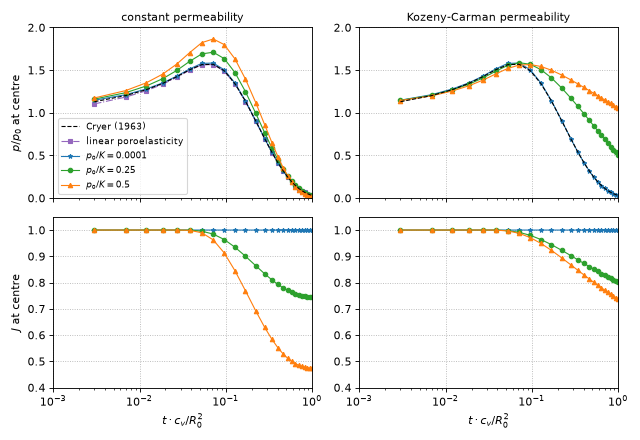
In test/poromechanics/poroelastic_large_deformations/cryer of the build directory, run_benchmark.py generates sphere_eighth.msh with gmsh if it does not exist, runs the cases of the table and plots them with plot_cryer.py (requires numpy and matplotlib); plot_cryer.py writes the figure above as cryer_overview.png:
A single case of each model, in test/poromechanics of the build directory:
Each run writes the centre time series to cryer_center_pressure.csv in its directory.
3.11-dev
Generated by  1.16.1