 |
version 3.11-dev
|
|
version 3.11-dev
|
Problem Description
This benchmark tests the Kirchhoff-Love plate model against an analytical solution. The problem is a clamped circular plate of radius \(R\) subject to a uniform out-of-plane load \(F\).
In the Kirchhoff-Love model the rotation field is identified with the gradient of the vertical deformation, \(\boldsymbol{\theta} = \nabla w\), so the fourth-order equilibrium equation is
\begin{align}\nabla\cdot(\nabla\cdot(\mathbf{M}(w))) = F \quad \text{in } \Omega,\end{align}
where the moment tensor for an isotropic material is \(\mathbf{M}(w) = -D(\mathbf{x})\left\{(1-\nu)\nabla\nabla w + \nu\,\Delta w\,\mathbf{I}\right\}\) and \(D(\mathbf{x}) = Et^3/(12(1-\nu^2))\) is the (potentially spatially varying) bending modulus. For uniform \(D\) this simplifies to \(D\,\nabla^4 w = F\). The plate is clamped at the boundary:
\begin{align}w = 0, \quad \nabla w \cdot \boldsymbol{n} = 0 \quad \text{on } \partial\Omega.\end{align}
The fourth-order equation is reformulated as a coupled system of second-order equations using a Helmholtz decomposition of the shear resultant (see the model documentation).
Analytical Solution
For a clamped circular plate of radius \(R\) under uniform load \(F\) the analytical solution is
\begin{align}w(r) = -\frac{F}{64D}\left(R^2 - r^2\right)^2,\end{align}
where \(r = \sqrt{x^2 + y^2}\).
Parameters
| Parameter | Symbol | Value | Unit |
|---|---|---|---|
| Young's modulus | \(E\) | \(10^6\) | Pa |
| Poisson ratio | \(\nu\) | 0.3 | - |
| Plate thickness | \(t\) | 0.05 | m |
| Bending modulus | \(D = Et^3/(12(1-\nu^2))\) | \(\approx 11.45\) | Pa·m³ |
| Load | \(F\) | 1.0 | N/m² |
| Radius | \(R\) | 1.0 | m |
Setup
The domain is a unit disk discretized with an unstructured triangular mesh generated by Gmsh from disk.geo. The mesh size \(h\) controls the resolution. The mixed formulation uses two coupled sub-problems discretized with control-volume finite element (CVFE) methods: the Box scheme (PQ1 CVFE (Box) scheme) for the deformation sub-problem \((\varphi, w, \psi)\) and the PQ1-Bubble scheme (PQ1-B CVFE scheme) for the rotation sub-problem \(\boldsymbol{\theta}\), coupled via the Multidomain framework framework.
Results
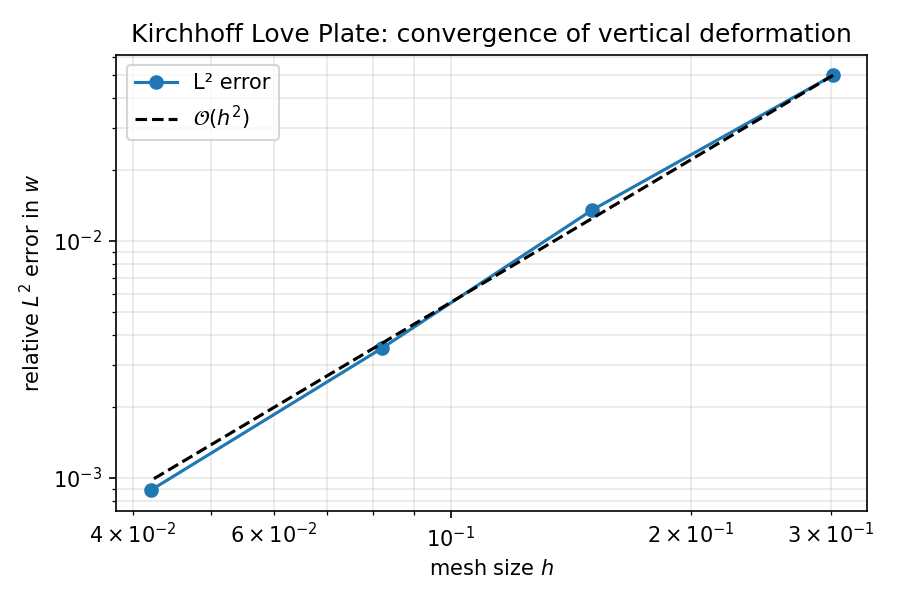
To run the convergence test and produce the convergence plot, run:
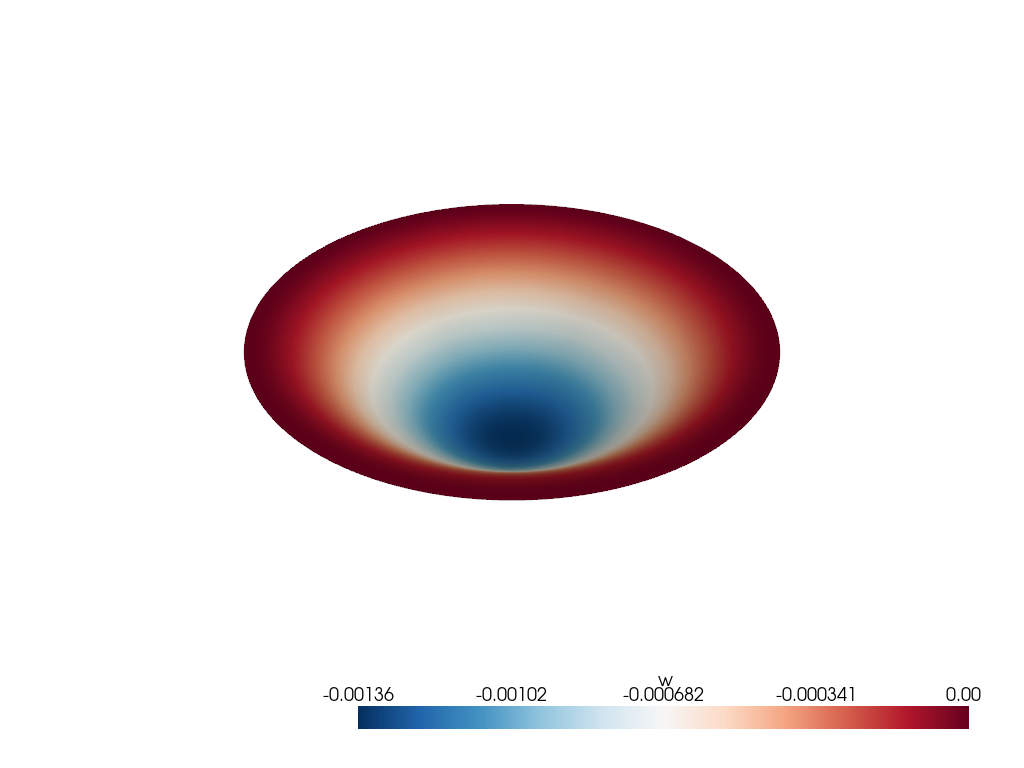
The script produces two figures:
 3.11-dev
Generated by
3.11-dev
Generated by  1.16.1